I’ve spent the past year slowly working my way through Roberto Bolano’s 2666.
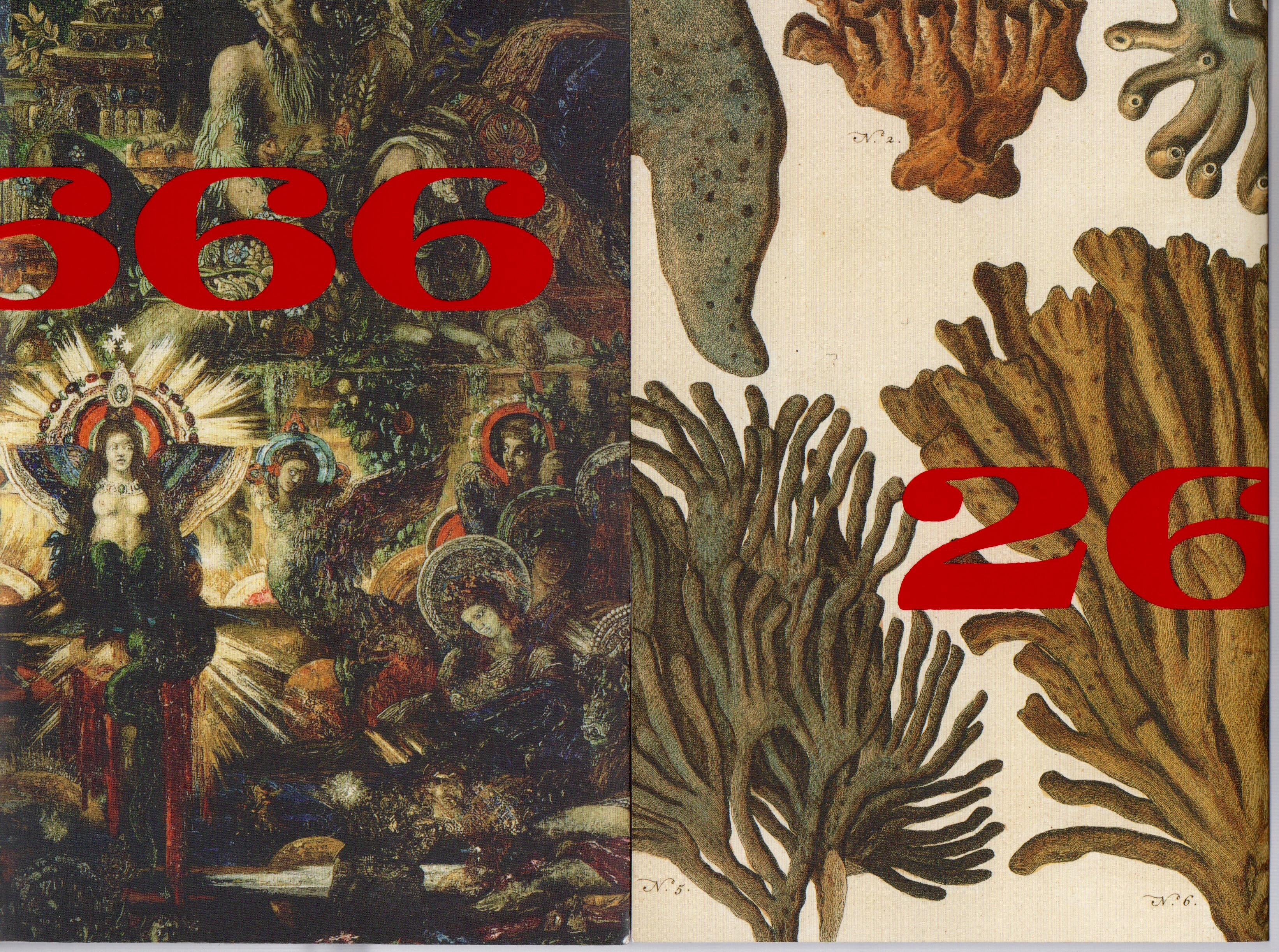
She thought botanomancy, or the art of predicting the future through plants, was trickery. Still, she knew how it worked, and once she explained to a third-rate healer the different branches of the divinatory art of botanomancy, namely: floromancy, or the study of the shapes, movements, and reactions of plants, subdivided in turn into cromniomancy and fructomancy, the reading of sprouting onions or fruits, and also dendromancy, the interpretation of trees, and phyllomancy, the study of leaves, and xylomancy, or divination using wood and tree branches, which, she said, is lovely, poetic, but has more to do with laying the past to rest and nurturing and pacifying the present than predicting the future. Then came cleromantic botanomancy, subdivided into favomancy, practiced with several white beans and a black bean, as well as the disciplines of rhabdomancy and belomancy, in which wooden rods were used.
Information Extraction
Almada has a rich ontology of time. Some modes of divination (like xylomancy or phyllomancy) are better at dealing with the past while others (like botanomancy) are better at dealing with (and predicting!) the future. The use of various mediums (by Almada of flowers, fruit or onions) is a use of the trapped information about the future or the past using features latent/embodied in objects in our present.
Prediction markets have lately been taking off in popularity. There is a larger trend of the casinofication of the economy (everyone is gambling, and no one is happy), but I’m very interested in the implications of settling contracts based on predictions of the future using data from the noosphere - the sum of ecosystems produced by human cognition and computation.
Both divination and participation in a prediction market are similar in that they rely on present information to infer about a future state. Divination relies on the decompression of future states latent in nature, while prediction markets use what is available (or been made available) to the collective.
Collective participation in a prediction market adds a deterministic mechanism, which worries me. Actors are recruited by contract prices to influence the outcome of a bet.
Here are some recent examples which have raised eyebrows:
- The outcome of a bet on the realtime capture of the Ukranian city of Myrnohrad was tampered with when the think tank that manages the map (that determines the outcome) was incorrectly edited - resolving towards the group that bet it would fall to the Russians.
- Sports betting taking on a life of its own with elaborate parlays. There was a phenomenon in the summer of dildos being thrown onto WNBA game courts - and you could bet on if it happened at future WNBA games on Polymarket. TrueAnon has a great episode here on collusion between players and bookies too.
- Polymarket tweeting a rumor about Trump announcing war with Venezuela, effectively juicing multiple NatSec related contracts.
I’d be a little less worried if Kalshi and Polymarket operated purely as arbitrages and disconnected third parties. On X however they’re regularly dipping their toes in, posting ragebait and commenting on current affairs (usually followed by a link to a contract based on said affair). So they’re either:
- Malicious actors, using contracts and incentivizing actors to steer how the future unfolds,
- Technologists incapable of thinking through second-order effects.
On the first, there is no evidence of collusion. I maintain though that active participation in discourse (thereby generating information/signals) about the future while operating the market is to no longer take the position of a neutral arbiter.
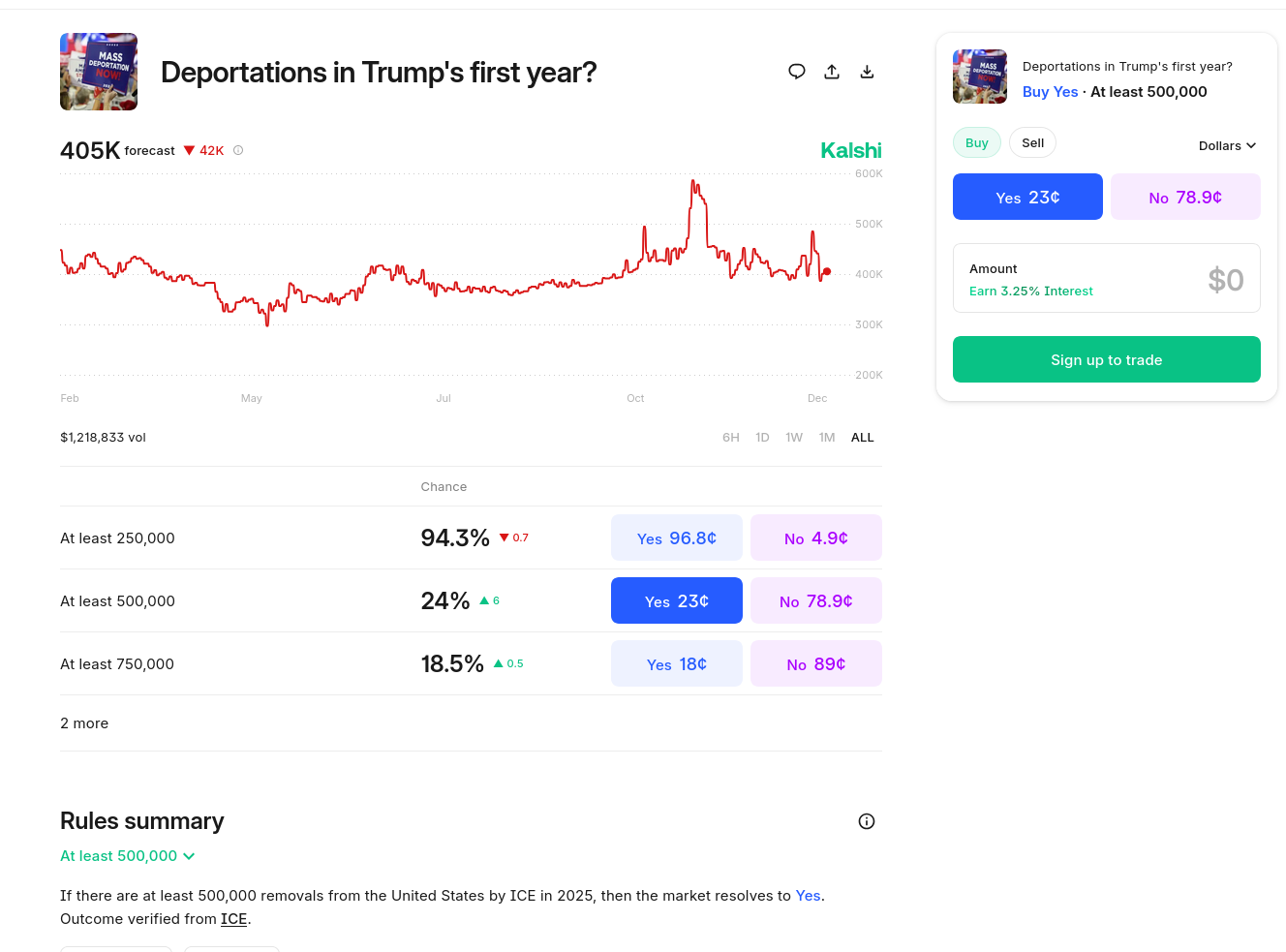
I’m more inclined to believe the second, because it’s the simplest explanation and that the unintentional stumbling into reality-warping is not unprecedented in recent history. When H1-B regulations were hastily modified over the summer, the official Kalshi account posted “all 55 million visa holders in the U.S. are being reviewed for deportable violation” - a lie - which also influenced existing contracts like the below (w/ currently > $1m in volume):
Hyperstition
So where does (in Kalshi CEO’s own words) the long-term financialization of everything and creation of a tradeable asset out of any difference in opinion get us?
Nick Land while at CCRU coined the term hyperstition, which is a kind of self-fulfilling prophecy enabled by a hyperconnected world where information is fungible and has no movement penalty/cost. To Land:
“A positive feedback circuit including culture as a component. It can be defined as the experimental (techno-)science of self-fulfilling prophecies. Superstitions are merely false beliefs, but hyperstitions — by their very existence as ideas — function causally to bring about their own reality.”
From Anna Greenspan (also CCRU-affiliated):
“Hyperstition aims to flatten the transcendence of superstition. Nowhere is this immanence more obvious than in the role hype plays in the market. Here hype acts concretely as an ’element of effective culture that makes itself real’, where reality is precisely measured in $. This connects hyperstition directly to the plane of unbelief. There is no need to believe in cyberhype, Chinahype etc… to make a fortune. All that is required is the ability (or luck) to cash in and out at the right point of the hype cycle.”
Taking Greenspan’s point one step further, I believe there’s a cost associated with participation in the prediction market. The math around prediction markets are Bayesian in aspiration, but hyperstitious in effect - the assumption is that events are passively observed but the very act of placing a bet is an intervention. Worse, the intervention produces a world that forces convergence, steering us towards simulacra.
Baudrillard gives us a framework to map the steps towards this convergence. The world that is constructed through simulations of experience and events slowly become the reality we collectively experience. And so in this framework:
- The markets reflect reality (through price discovery)
- The market masks or perverts reality (here is the hyperstition - the bets recruit actors to make a prediction true)
- the market masks the absence of a stable reality (Myrnohrad - what actually happened on the ground?)
- A simulacrum is generated (with prices reflecting prices, contracts referencing contracts)
The stages are a trajectory, starting at step 1 inevitably leads you to step 4. Liquidity (of both capital and information) pushes towards the construction of simulacrum. The simulacrum becomes possible when signals detach from their sources and circulate freely, when the map is no longer tethered to the territory it claims to describe.
Abstraction Avoidance
The four stages then depend on the availability of information. We’ve gotten a lot better at its production, strip mining reality for data that requires algorithmic systems to process - where now access to a signal is mediated by a third party. This is related to the noosphere mentioned earlier, the data generated and computed becomes a part of the space we are collectively steeped in.
I think this mechanism is key in the simulacra mentioned earlier. The hyperstition arises when information is no longer local.
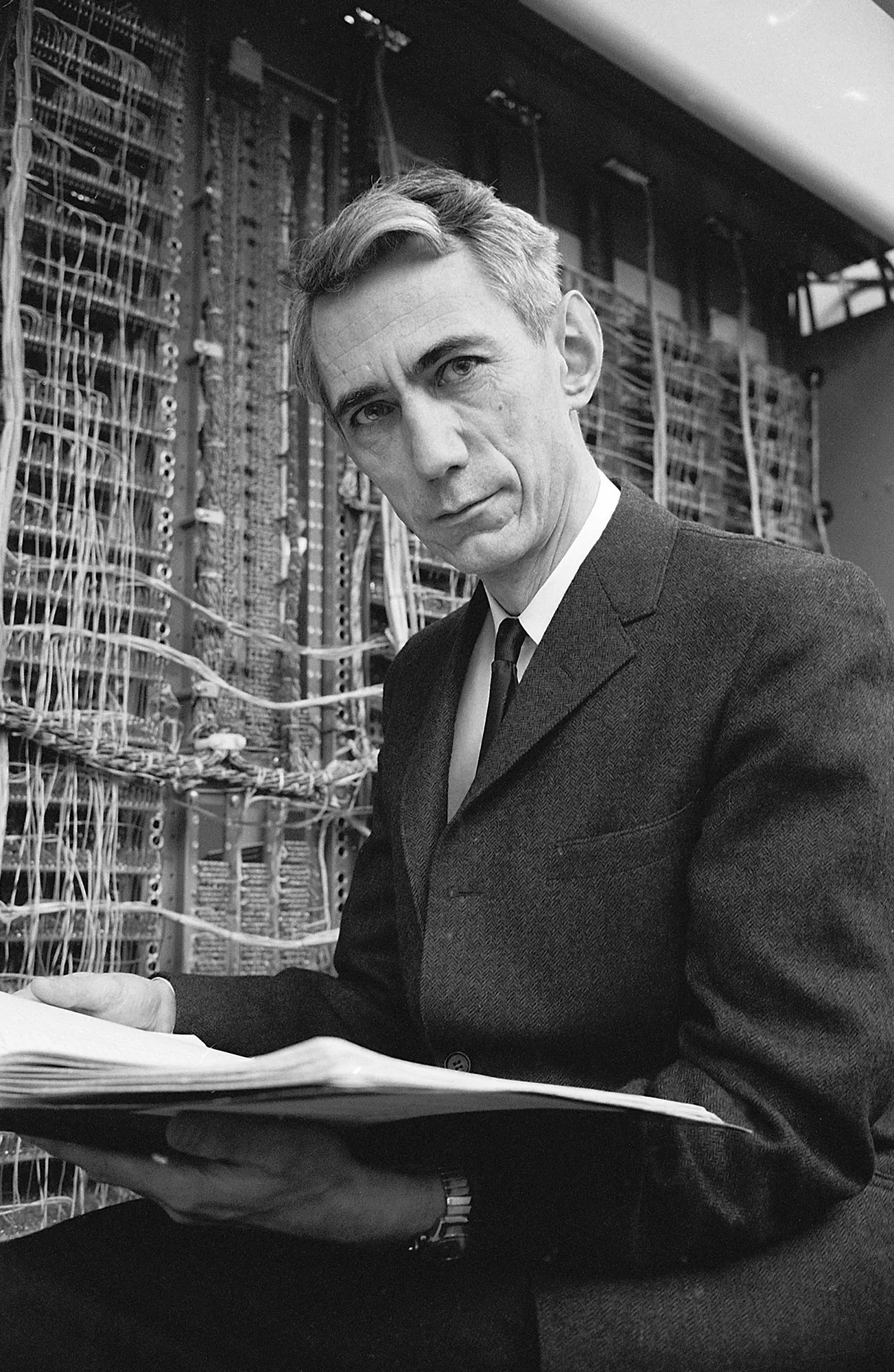
Claude Shannon’s insight was that information is a reduction of uncertainty. A message is informative to the extent that it narrows possibilities. Prediction markets claim to do exactly this, aggregate dispersed signals to reduce uncertainty about the future.
Shannon however assumed a passive channel, where the message doesn’t change the source. In prediction markets, the price feeds back into the system it’s measuring.
And so here is where I see Florita Almada’s divination as different from the placing of a bet on a prediction market. At no point does a middleman or broker exist between her and the flowers or tea leaves she reads. She is party to the truth encoded in nature around her, which eludes abstraction and is embodied.
Participation in a prediction market in contrast necessitates the use of brokered information that is self-referential. The markets cease to function as simulations modeling probable futures because the incentive structure pushes them towards becoming self-referential systems that replace the real.
Assorted Notes
- https://en.wikipedia.org/wiki/Witchcraft,_Oracles_and_Magic_Among_the_Azande
- Betting on the future has historical precedence as a bad thing. Gharar in Islam describes the prohibition of trading in uncertainty and the “sale of what is not yet present”.
- I wanted to formalize some of the information theory, but I think I’ll leave that for later. I’ve been slowly working through the Evolution of Biological Information which I highly recommend.
- I think prediction markets are also different from normal markets because they’re lacking abstraction over ground truth. There’s a difference between trading wheat futures because you saw the war in Ukraine coming and betting directly on the outcome of a single battle.