I knew a Californian who read his poetry aloud at parties until his friends learned to silence him. But when he played recordings of these same poems, everyone listened.
Ghost in the Shell
Some of my favorite media come from the Ghost in the Shell franchise, namely the 1995 movie and the Stand Alone Complex (SAC) animes, which explore themes that feel increasingly relevant today. SAC especially I’ve revisited multiple times over the last few years and can find something new to think about everytime, especially given how drastically different the last few years have been.
The first season’s plot revolves around stochastic terror in response to public-private enterprise gone wrong (cybernetic enhancements going to the rich, a surveillance state gone rogue, suppression of an inexpensive cure for a disease to maintain profits) while the second season takes a unique tack on a refugee crisis, nuclear security and memetic viruses.
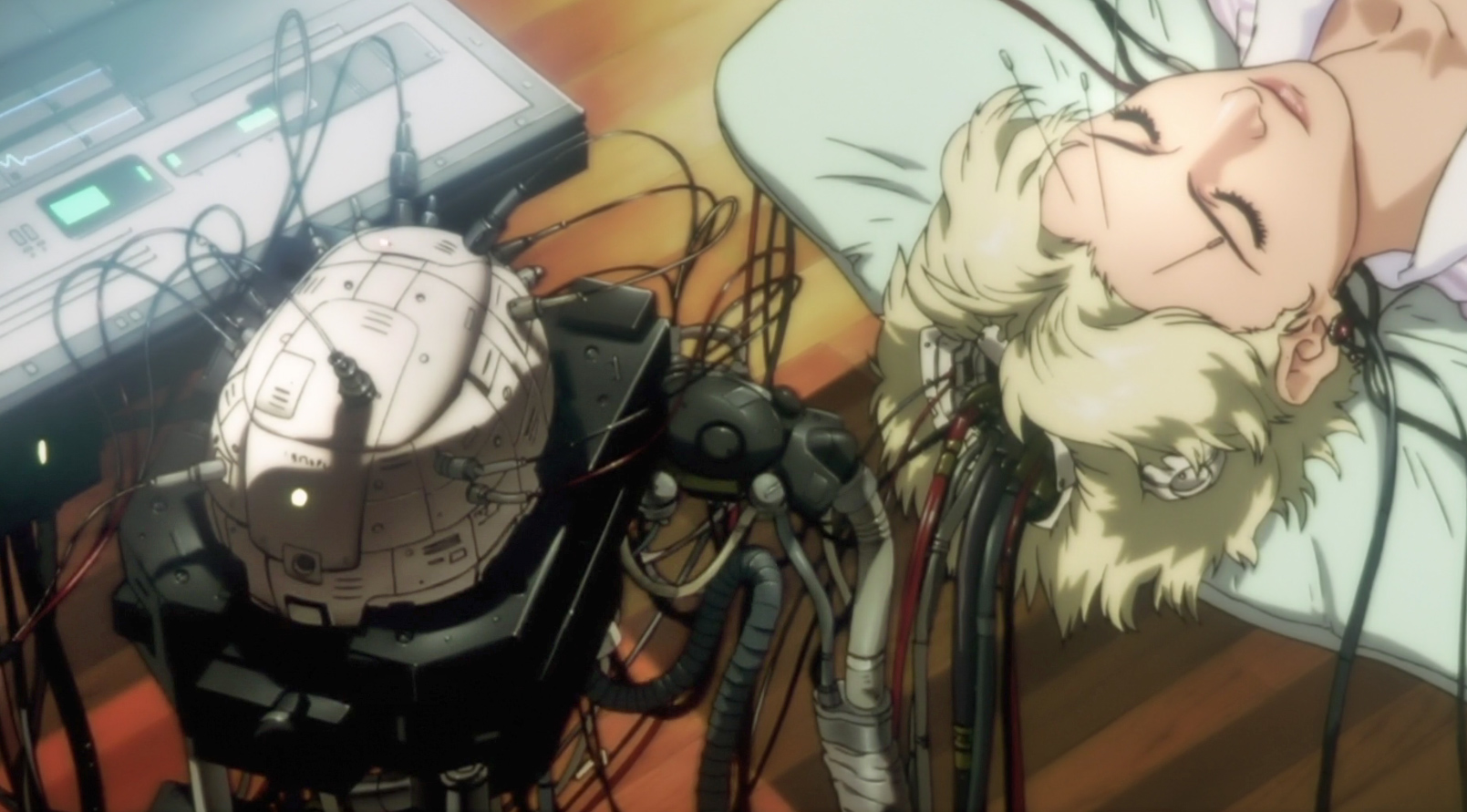
What I see at the core of it all however is the friction between minds untethered from the physical and a physical that continues regardless. This makes for some great storytelling. Without spoiling too much, here are a few standalone beats that have stayed with me:
- S01E02. In the world of GiTS, some military equipment (like tanks and helis) are enhanced w/ AI. A tank’s designer combines w/ its AI, and takes on the designer’s desires.
- S01E12. A cyberbrain is discovered in a dump, and when it’s accessed it’s revealed to be that of a cult filmmaker. Other personalities exist in the cyberbrain too, those that have become lost/stuck by interfacing with the brain. The brain captures the visitor with a movie that doesn’t have a beginning or end.
- S02E04. During a live fir e drill by the JSDF, a helicopter pilot suffers a heart attack while interfaced w/ the heli’s AI. The dying signals of duress are interpreted by the AI as a large scale attack, and the misinterpretation propagates to other AIs in the fleet.
- S02E12. A terrorist group is infected with a mimetic virus spread through political essays. On further investigation though, the essays don’t exist - it’s the metanarrative around them and what they contain that turn out to influence the members.
The shell in Ghost in the Shell is the physical, and so at the core of every story is the question of what and where the ghost is; asking questions in line of Leibniz’s spiritual automata.
The world of GiTS is rich and has a lot of parallels with what I encounter daily; both as a facilitator of the AI enterprise and a consumer/observer/participant in the discourse around it. These however, are clearly the early days. While we don’t have the dense mediums of the GiTS world that allow for cybernetic brains and the manipulation of the mind, we come eerily close with other mechanisms that in their imperfections lead to interesting emergent dynamics.
Angelization
Edmund Carpenter was an anthropologist that wrote primarily about tribal art, visual media and how media influences perception. Carpenter develops the concept of an angel from Oh What a Blow That Phantom Gave Me:
Electricity has made angels of us all - not angels in the Sunday school sense of being good or having wings, but spirit freed from flesh, capable of instant transportation anywhere.
When a clerk stops waiting on us to answer a phone, we accept this without protest, yet it violates one of our most precious values - barbershop democracy. We accept it because pure spirit now takes precedence over spirit in flesh.
Ghosts are the same things as angels here, so pure ghosts/spirits/angels take precedence over spirit in flesh. This was written in the 70s! Carpenter is talking about landlines, TV and radio here; far before the internet and LLMs.
I think it maps cleanly though to modern phenomena, where we are voluntarily producing ghosts/angels of ourselves to live on the internet. The people we interact with online are then also models, and so I’m regularly reminded of this diagram:
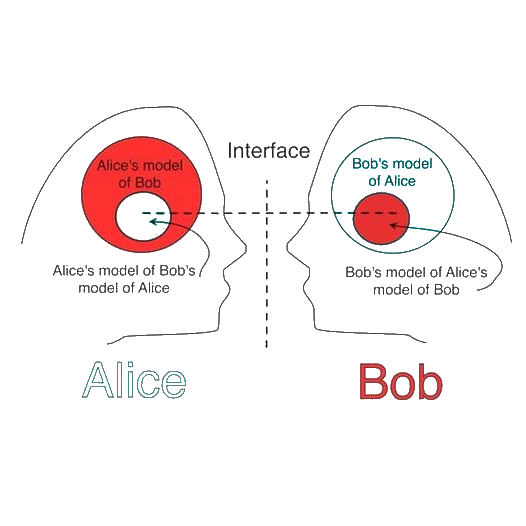
Algo-mediated conversation nests it even further; the interaction is between you and the model of a model. When I send a reel to a friend (that was surfaced by one of the networks Meta assumes you belong to), my online model is presenting a model built by Meta (based on my preferences built from seconds I spend on a reel and what I like).
When my friend says “this is me fr” in response, they are in turn captured into the structure.
Second-layer models are then generated by a third party, and continue nesting downwards to further capture mechanisms that all take a bite and build their own ghost of me. Continuing the example above:
- My angel (created by me to interact w/ the internet) scrolls on reels
- Meta builds a model/ghost/angel of me and assigns it various preferences based on close surveillance
- A piece of that model is split off and sold to an advertiser in a bidding market, who then form a third model/ghost/angel to sell again
These are passive activities of consumption, but production serves the same purpose (via writing, uploading photos, etc).
Involuntary Angelization
Setting aside voluntary disembodiment for a moment, we should also look at labor; something that Carpenter didn’t necessarily predict. The systems that surround us are being built with disembodied labor, from:
- Training dataset labeling outsourced to people in the Philippines; often referred to as digital sweatshops.
- Amazon’s Mechanical Turk system, which outsources for human labor through an API. AWS is cheeky with their naming here, giving a wink and nod to the real mechanical turk - an automated chess playing machine built in 1770 that was actually controlled by a player hidden in a lower cavity.
- Content moderation, with workers often spending days watching beheading, child abuse imagery and more - often developing PTSD from exposure.
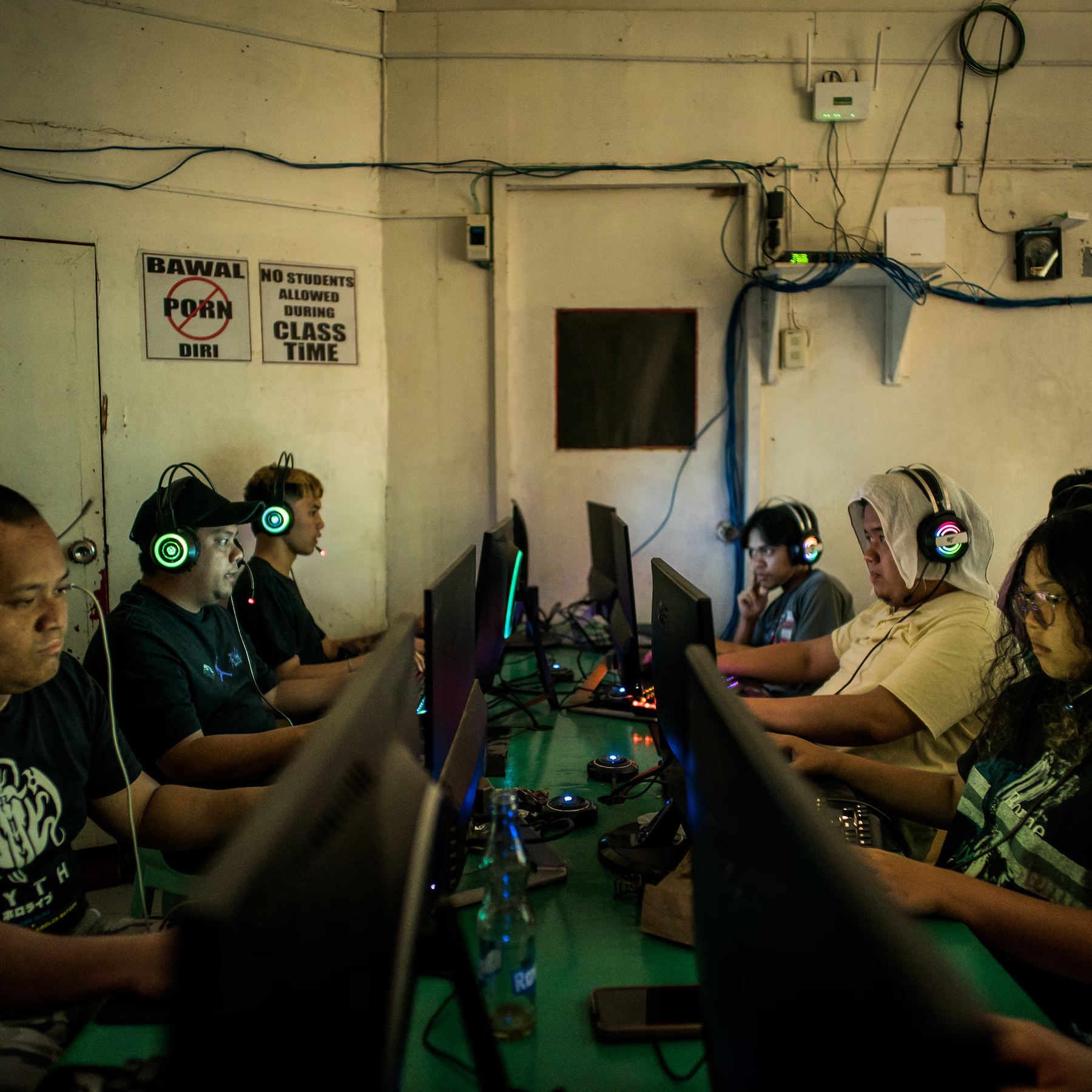
In all cases, their labor is sold through their disembodied work, cognitive cycles spent away from the physical realm. The value of their physical form is often inversely proportional to their value to capital (cheaper to hire the further they are from it).
The purest form of this is the most evil, when the individual is caged and the spirit deployed. 68% of Myanmar’s GDP (~$40B a year) for example comes from just this; where people are kidnapped/trafficked and forced to run scam call centers. The contrast between the physical and the spirit is at its most extreme here, with a depressing dialectical synthesis at the end, where their organs are harvested and sold. The synthesis of disembodied labor and global computation eliminates the need for flesh.
Rhizomes, Global Computation
And so we get to synthesis and capture. Rhizomes (coming from greek word for root systems) are defined by Deleuze & Guattari as networks that establish connections between symbols, organizations of power and circumstances; without any predefined ordering or entry point. This is in contrast with arborescent (tree-like) systems which have a natural hierarchy.
The Ghost in the Shell SAC series concludes (for me at least, the followups aren’t great) with the Solid State Society movie. A central plot beat is the existence and autonomy of a rhizome or collective consciousness formed by senior citizens hooked up to automated nursing machines.
I think a similar mechanism is emergent today, one of rhizomatic capture - both voluntary and involuntary; voluntary through participation and involuntary through coercion (either by capital or (in extreme cases) enslavement). I touched on this earlier with the Meta/reels example. Recommendation systems and attention capture have been around for a while, but have slowly been marching towards purer and more capable forms of capture. This is similar to Deleuze’s apparatus of capture, defined in the context of the State that creates conditions to capture the energies of society to further production.
LLMs are similarly an apparatus of capture, with a voracious appetite for ghosts. Just like the scam call centers in Myanmar however, there is a physical cost in enabling the free circulation of ghosts.

LNG, labor (both physical and cognitive) is burned at datacenters to facilitate global computation using both involuntary and voluntary rhizomatic capture. The ghosts that were voluntarily built and joined networks (on message boards, forums or groups) are distilled into their vector-space representations. Forums and message boards come with their own hybrid topology, both arborescent (hierarchy in message boards, subcultures) and rhizomatic (distributed, self-organizing).
Part of capture is destructive however, as the original relationships between the ghosts are stripped and replaced with nearest-neighbor representations in the model’s latent space. My ghost is vacuumed and neatly filed next to someone else’s, just because we both happened to double-tap on a reel at approximately the same time. My network then consists of people sorted the same way, which in reels manifests as randos in comments replying to something obscure like an agartha edit of a monkey with an SS armband w/ “gem alert”.
Assorted Notes
- If you decide to start watching Ghost in the Shell SAC based on this, please do not be fazed by the obvious gooner-bait character design of Kusanagi. Just chalk it up to an anime quirk and keep watching.
- While on the subject of goon-baiting, reels deploy it as a quick capture mechanism if their model of you is dated. I’ll find that if I’m off it for a week or so, my first few reels are me getting flashbanged by softcore porn (increasingly AI porn too). I often have to “work” to get captured into a model that is more decidedly “me”, which impressively only takes a few minutes of scrolling.
- Good read into Scale AI’s labor practices and the reality of their AI product (pre-acquisition): https://relationaldemocracy.medium.com/an-authoritarian-workplace-culture-4ba5f3666f9f
- This is a great writeup of the intersection b/ween algorithmic capture, linguistics and D&G: https://networkologies.wordpress.com/2009/10/24/86/
- My favorite song from the GiTS SAC soundtrack: https://www.youtube.com/watch?v=YkPQrWJDCyA&list=PL01FEFECDCC70CD0E&index=56. The entire OST is great.
- I’m rereading this right before publishing and there’s a thread I didn’t expand enough on that I plan to soon on cybernetics and the difference in friction between the physical and digital worlds. IMO the increasing friction of operating in the real (and potentially our collective inability to cope with it) pushes us further into the digital, further decreasing our tolerance for friction. The breakdown in expected outcomes (like a flight app not updating for cancelations that are very real and experienced by the body) is an interesting emergent phenomenon. Kyla Scanlon writes about this here and I super recommend it.